Are you a B2B marketer or business leader constantly striving for predictable, scalable revenue growth? The answer lies in effective demand generation. But with so much noise and so many tactics, how do you cut through the complexity? This isn’t just about getting more leads; it’s about generating qualified demand that consistently fuels your sales pipeline. In this comprehensive guide, we’ll demystify demand generation by breaking down the 3 key frameworks for demand generation that every high-growth company is leveraging. Master these, and you’ll be well on your way to transforming your marketing efforts into a true revenue engine.
What is Demand Generation? (Brief Definition & Keyword Rich)
Before diving into the frameworks, let’s quickly define demand generation. It’s a data-driven marketing strategy focused on creating interest in a product or service, nurturing that interest, and converting it into sales. Unlike traditional lead generation, demand gen takes a broader, holistic approach, building brand awareness, thought leadership, and trust long before a prospect is ready to buy. It encompasses everything from content marketing and SEO to email marketing and paid advertising, all working in harmony.
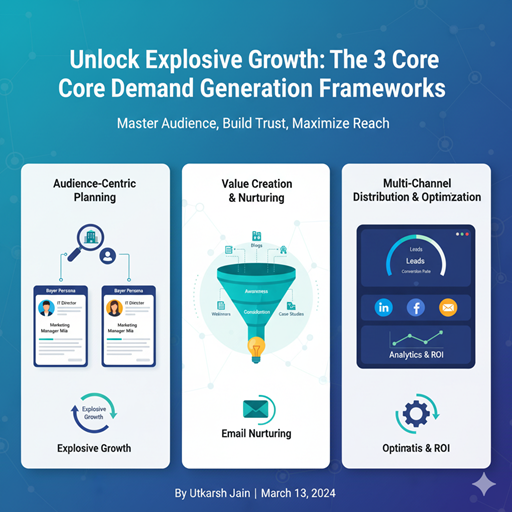
The 3 Key Frameworks for Demand Generation
Think of these frameworks as the foundational pillars supporting your entire demand generation strategy. Each plays a crucial role, and when combined effectively, they create a powerful, self-sustaining growth loop.
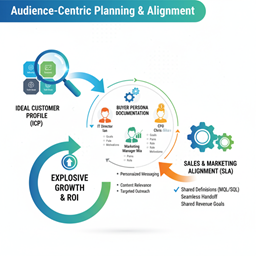
Framework 1: Audience-Centric Planning & Alignment (The “Be Ready” Framework)
The Core Idea: You can’t generate demand effectively if you don’t deeply understand who you’re trying to reach and ensure everyone internally is aligned on that target. This framework is all about preparation, deep research, and strategic alignment between marketing and sales.
Why it’s Critical:
Precision Targeting: Avoids wasting resources on unqualified prospects.
Message Resonance: Ensures your content and campaigns speak directly to your audience’s needs.
Internal Harmony: Aligns marketing and sales teams on shared goals and definitions.
Key Components & Documentation:
Ideal Customer Profile (ICP) Documentation:
What it is: A detailed description of the type of company that benefits most from your solution and provides the most value to you. It’s the “who” at the organizational level.
Why it matters: Filters out unsuitable accounts, allowing you to focus your resources.
What it is: A semi-fictional, detailed representation of the individual decision-maker or influencer within your ICP company. This is the “who” at the personal level.
Why it matters: Personalizes messaging, content, and sales outreach.
Includes: Demographics, Job Role, Goals, Challenges, Buying Behavior, Information Sources.
Sales & Marketing Alignment (SLA):
What it is: A formal agreement defining lead definitions (MQL, SQL), handover processes, and shared revenue goals.
Why it matters: Ensures a seamless transition from marketing-generated demand to sales-closed deals.
Infographic:
Framework 2: Value Creation & Nurturing (The “Be Helpful” Framework)
The Core Idea: Once you know who you’re talking to, this framework focuses on attracting them by providing immense value through content, building trust, and guiding them through their buyer journey with empathetic nurturing. It’s about educating and solving problems, not just selling.
Why it’s Critical:
Attracts Qualified Leads: Draws in individuals actively seeking solutions to their problems.
Builds Trust & Authority: Positions your brand as a helpful expert, not just a vendor.
Shortens Sales Cycles: Educated prospects are more likely to convert faster.
Key Components:
Content Strategy & Creation:
What it is: Developing high-quality, relevant content at every stage of the buyer’s journey (awareness, consideration, decision).
Why it matters: Answers questions, addresses pain points, and establishes thought leadership.
Examples: Blog posts, whitepapers, webinars, case studies, videos, interactive tools.
SEO & Keyword Optimization:
What it is: Optimizing your content and website to rank higher in search engine results for relevant demand generation keywords and phrases.
Why it matters: Increases organic visibility and attracts passive searchers looking for solutions.
Lead Nurturing & Email Marketing:
What it is: A systematic process of engaging prospects over time through a series of relevant communications, primarily via email marketing.
Why it matters: Keeps your brand top-of-mind, deepens relationships, and moves prospects further down the funnel.
Infographic Suggestion for Framework 2: A funnel graphic with “Awareness,” “Consideration,” “Decision” stages, showing different content types flowing through it (blogs, webinars, case studies), and an email icon for nurturing.
Infographic:
Framework 3: Multi-Channel Distribution & Optimization (The “Be Seen” Framework)
The Core Idea: You’ve created great content and know your audience—now it’s time to get that content in front of them effectively across various channels and continuously optimize your performance for maximum ROI.
Why it’s Critical:
Wider Reach: Expands your visibility beyond organic search.
Targeted Delivery: Ensures your message reaches the right people on the right platforms.
Data-Driven Improvement: Allows for continuous refinement of your strategy to maximize results.
Key Components:
Multi-Channel Content Distribution:
What it is: Strategically promoting your content across various online platforms where your ICP and buyer personas spend their time.
Why it matters: Increases touchpoints and awareness.
Examples: Paid Social (LinkedIn Ads), Paid Search (Google Ads), Organic Social Media, Influencer Marketing, Online Communities.
Lead Scoring & Prioritization:
What it is: A system that assigns points to leads based on their engagement with your content and their fit with your ICP, helping identify the most sales-ready prospects.
Why it matters: Ensures sales teams focus their efforts on the highest-quality leads, increasing conversion efficiency.
Analytics & Continuous Optimization:
What it is: Tracking key metrics (website traffic, conversion rates, cost per lead, ROI) and using that data to refine your strategies, channels, and content.
Why it matters: Enables iterative improvement, ensures efficient spend, and drives predictable growth.
Tools: Google Analytics, CRM dashboards, Marketing Automation platforms.
Infographic:
Conclusion: Your Path to Predictable Demand Generation
Mastering the 3 key frameworks for demand generation isn’t just a marketing advantage; it’s a business imperative for sustainable growth. By meticulously understanding your audience, consistently providing value through strategic content and nurturing, and then intelligently distributing and optimizing your efforts across multiple channels, you build a robust engine that delivers predictable revenue. Stop chasing leads and start generating demand—your pipeline (and your bottom line) will thank you for it.
FAQs about Demand Generation Frameworks
Q1: What’s the difference between demand generation and lead generation? A1: Demand generation is a broader, strategic approach focused on creating overall interest and awareness for your product/service, nurturing prospects from early engagement to sales readiness. Lead generation is a specific subset of demand gen, focused purely on collecting contact information from potential customers. Demand gen builds the “ecosystem” for leads to thrive.
Q2: How long does it take to see results from demand generation? A2: Demand generation is a long-term strategy. While some tactical gains can be seen in weeks (e.g., ad campaign performance), building strong brand awareness, trust, and a robust pipeline typically takes 3-6 months to show significant, consistent results. It’s an investment in sustainable growth.
Q3: Can small businesses use these demand generation frameworks? A3: Absolutely! The principles apply universally. Small businesses can adapt these frameworks by focusing on a very niche ICP, creating highly targeted content, leveraging organic channels effectively, and carefully choosing their distribution channels based on budget and audience. The key is consistent application.
Q4: Is email marketing still essential for demand generation? A4: Yes, email marketing remains one of the most powerful and cost-effective channels for demand generation, especially for nurturing leads. It allows for personalized communication, deep segmentation, and direct delivery of valuable content, playing a crucial role in moving prospects through the buyer’s journey.
Ready to implement these demand generation frameworks and unlock your growth potential? Contact us today for a free consultation to assess your current strategy and build a customized demand generation roadmap!
Stop Guessing, Start Growing: How Data Fuels Demand Generation Success
Are you tired of marketing strategies that feel more like wishful thinking than strategic action? In today’s saturated digital landscape, relying on outdated “spray and pray” techniques is a recipe for wasted resources and stagnant growth. Real, sustainable success hinges on data: a deep, actionable understanding of your audience and their journey. At [Your Company – Insert Your Company Name Here], we’ve seen this transformation firsthand, helping clients across industries unlock exponential growth through the power of data-driven demand generation. This article breaks down the key challenges facing modern marketers and unveils the strategies you need to build a powerful, data-fueled engine for demand.
From Lead Generation to Data-Driven Demand Creation: A Critical Paradigm Shift
Traditional lead generation often gets stuck on simply capturing contact information. It’s a numbers game, where quantity trumps quality. Data-driven demand generation flips that script. It prioritizes creating genuine need by understanding your audience on a deeper level, educating them about the value of your solutions, and carefully nurturing them along a personalized buyer’s journey.
This shift demands a change in mindset: from casting a wide net to targeting specific fish with the bait they find irresistible.
Common Demand Generation Challenges (and How to Crush Them with Data)
Most organizations struggle to unlock the full potential of their demand generation efforts. These challenges often stem from a lack of clear, data-driven insights. Here’s how to conquer them:
Challenge #1: Identifying Your Ideal Target Audience
The Problem: Broad targeting is a resource black hole, diluting your message and failing to resonate with the right people. Casting your net for “marketing managers” is simply too broad.
The Data-Driven Solution: Leverage Customer Data Platforms (CDPs), CRM data, and marketing automation intelligence to build hyper-specific buyer personas and segmentation strategies. Think “marketing managers at B2B SaaS companies with $5-10M ARR, struggling with low lead quality and actively researching marketing automation solutions.”
Actionable Tip: Ditch assumptions. Conduct regular customer interviews and surveys to supplement your quantitative analysis with invaluable qualitative insights. What are their real pain points? What motivates their buying decisions?
H3: Challenge #2: Creating Content That Engages and Converts
The Problem: Generic, uninspired content gets lost in the noise, leading to low engagement, weak conversion rates, and ultimately, wasted effort.
The Data-Driven Solution: Become a data detective. Analyze content performance (page views, time on page, bounce rate, social shares, conversion rates) using tools like Google Analytics and BuzzSumo to identify the formats, topics, and styles that resonate most powerfully with your audience. A/B test everything to continuously optimize for maximum impact.
Example: You might discover that long-form, in-depth blog posts packed with actionable tips and compelling case studies consistently outperform shorter, more superficial content.
Actionable Tip: Map your content to the buyer’s journey, providing the right information at the right time to nurture prospects towards a purchasing decision. Think awareness, consideration, decision.
Challenge #3: Accurately Measuring Your Demand Generation ROI
The Problem: Many marketers struggle to connect revenue back to specific demand generation activities, making it nearly impossible to justify investments and optimize their overall strategy.
The Data-Driven Solution: Implement robust tracking and attribution models (e.g., multi-touch attribution) to understand the complex customer journey and precisely measure the ROI of each campaign and channel. This requires seamlessly integrating your marketing automation platform with your CRM, and often, employing a dedicated attribution tool like Bizible or CaliberMind.
Example: By implementing a multi-touch attribution model, you might reveal that webinars are a crucial touchpoint in influencing deals, even if they don’t always directly generate a flood of leads.
Actionable Tip: Go beyond vanity metrics. Focus on measuring the impact of your demand generation efforts on core business metrics such as Customer Lifetime Value (CLTV) and Customer Acquisition Cost (CAC).
Challenge #4: Personalization at Scale: Delivering Tailored Experiences
The Problem: Providing truly personalized experiences for a large audience can feel overwhelming, resource-intensive, and nearly impossible to execute effectively.
The Data-Driven Solution: Embrace the power of marketing automation platforms and AI-powered personalization tools to deliver dynamic, tailored content and experiences. Personalize based on individual customer behavior, stated preferences, industry, company size, and intent data.
Example: Use dynamic content on your website to display different messaging to returning visitors based on their previous interactions with your brand or the specific industry they belong to.
Actionable Tip: Segment your audience based on shared characteristics and create personalized email nurture sequences for each distinct segment. Speak directly to their unique challenges and aspirations.
Advanced Data-Driven Strategies: Taking Your Demand Generation to the Next Level
Conquering common challenges is just the beginning. Data unlocks advanced strategies that can catapult your demand generation efforts to the next level:
Strategy #1: Account-Based Marketing (ABM) Fueled by Real-Time Data
ABM isn’t just about targeting specific accounts; it’s about gaining a deep understanding of their unique needs and delivering highly personalized experiences that resonate with key stakeholders.
Also have a look for more about Content Syndication
The Data-Driven Approach: Leverage intent data from platforms like Bombora or G2 to identify accounts actively researching solutions related to your offerings. Use this powerful intelligence to prioritize your ABM efforts and tailor your messaging to directly address their specific pain points and priorities.
Example: If you’re a cybersecurity company, you might target accounts displaying increased interest in topics such as ransomware protection, data breach prevention, or cloud security compliance.
Actionable Tip: Foster deep alignment between your sales and marketing teams. Collaborate closely on crafting personalized content and engagement strategies that speak directly to the needs of each target account.
Strategy #2: Predictive Analytics: Transforming Lead Scoring and Qualification
Say goodbye to gut feelings. Predictive analytics uses machine learning algorithms to analyze vast amounts of historical data and identify the characteristics most predictive of lead conversion.
The Data-Driven Approach: Implement a predictive lead scoring model to automatically assign scores to leads based on their likelihood of converting into qualified opportunities. This empowers your sales team to laser-focus their efforts on the highest-potential prospects.
Example: Your model might consider factors such as job title, company size, website activity, content downloads, webinar attendance, and social media engagement to assign a score to each lead.
Actionable Tip: Don’t set it and forget it. Continuously monitor and refine your predictive lead scoring model to maintain its accuracy and ensure it’s consistently delivering high-quality leads.
Strategy #3: Optimizing the Entire Customer Journey with Data-Driven Precision
Every touchpoint in the customer journey presents a crucial opportunity to engage, delight, and ultimately, influence prospects. Data empowers you to identify friction points and optimize the experience for maximum impact.
The Data-Driven Approach: Meticulously map the entire customer journey, from initial awareness to post-purchase support and advocacy. Analyze data at each stage to pinpoint areas for improvement. This includes everything from website analytics to customer surveys and feedback forms.
Example: By analyzing customer behavior data, you might discover a significant drop-off rate during a specific step in your product onboarding process. By simplifying that step, you could dramatically improve customer retention rates.
Actionable Tip: Embrace A/B testing to experiment with different approaches at each stage of the customer journey. Small tweaks can lead to significant improvements in engagement and conversion rates.
Strategy #4: Sales and Marketing Synergy: Building a Unified Data-Driven Front
Stop the madness of siloed teams! Sales and marketing must act as a cohesive unit, driven by a shared understanding of the customer and a common set of goals.
The Data-Driven Approach: Break down departmental silos by establishing a shared understanding of the customer journey, agreeing on key metrics (e.g., lead definitions, MQL to SQL conversion rates), and implementing formal Service Level Agreements (SLAs). This ensures that everyone is rowing in the same direction, towards the same ultimate goal.
Actionable Tip: Implement regular cross-functional meetings between sales and marketing teams. Encourage open communication, data sharing, and collaborative problem-solving.
Your Essential Data-Driven Demand Generation Tech Stack
Investing in the right technology is no longer optional – it’s a prerequisite for success in today’s data-driven marketing landscape. Here’s your essential toolkit:
Measuring What Matters: Key Performance Indicators (KPIs) for Data-Driven Success
Tracking the right KPIs is critical for understanding the true effectiveness of your demand generation initiatives. Prioritize these:
Lead Quality Metrics: (MQL to SQL conversion rate, SQL to Opportunity conversion rate)
Pipeline Velocity: (Time from lead creation to deal close)
Customer Acquisition Cost (CAC):
Customer Lifetime Value (CLTV):
Return on Ad Spend (ROAS):
Website Conversion Rates:
Use your technology stack to rigorously track and analyze these KPIs. Regularly review your performance data to identify areas for optimization and continuous improvement. https://skypire.com
The Future is Here: The Evolving Landscape of Demand Generation
The world of demand generation is in constant flux. Stay ahead of the curve by understanding these key trends:
The Ascendancy of AI and Machine Learning: AI-powered tools will automate repetitive tasks, personalize experiences at scale, and unlock deeper, more predictive insights into customer behavior.
The Imperative of Privacy and Data Governance: Complying with regulations like GDPR and CCPA will be paramount for building trust and maintaining customer loyalty.
The Rise of Account-Based Experiences (ABX): Extending ABM principles throughout the entire customer lifecycle will create seamless, highly personalized experiences.
The Value of First-Party Data: In a cookieless world, collecting and leveraging first-party data directly from your customers will become increasingly crucial for effective targeting and personalization.
Data-Driven Demand Generation: Your Path to Sustainable, Scalable Growth
Moving beyond the hype and embracing a data-driven approach is no longer a competitive advantage – it’s a necessity. By implementing the strategies outlined above, optimizing your technology stack, and meticulously tracking the right KPIs, you can transform your marketing efforts, drive sustainable growth, and achieve real, measurable results.
Ready to unlock the full potential of data-driven demand generation? Skypire Marketing Intelligence is here to help. Contact us today for a free consultation and discover how we can build a powerful, data-fueled engine to propel your business forward.
They chase new tactics, burn time testing things that don’t work long-term, and then wonder why they have no pipeline.
This guide is here to fix that.
What you’re getting is a full breakdown of how to set up a marketing ecosystem that runs like an infrastructure.
Instead of spending your life tweaking things that barely move the needle, you build a system once and let it do the heavy lifting.
It’s like setting up a gym routine that actually works—you don’t need a new workout every week, you just need to show up and let the process do its thing.
The whole thing is designed to be modular.
The top-of-funnel (how you bring in leads) is flexible—you can swap in different strategies like LinkedIn content, outreach, paid ads, cold email, whatever works best at the time.
The middle and bottom of the funnel? That’s standardized.
You build it once, and it keeps working in the background, automatically nurturing and converting leads.
No more chasing every shiny object that pops up on LinkedIn.
What we’re covering
How the B2B funnel actually works (not just in theory, but in a way that makes sense for sustainable growth).
How to plug in different lead gen methods at the top (so you’re not stuck relying on one thing and freaking out when LinkedIn reach dies for a week).
How to set up middle and bottom-of-funnel automation so the system runs on its own—warming up leads, sorting them based on engagement, and pushing the right ones to convert.
This isn’t another “growth hack” that works for a week and then falls apart. It’s a real infrastructure that keeps leads moving, so you’re not constantly starting from scratch. Set it up right, and it compounds over time. And if you do it properly, you’ll be booking meetings while doing absolutely nothing. Which, let’s be real, is the goal.
AND, if you want to watch this in a video format, check out our live training on this subject:
Most B2B marketing strategies are a complete mess.
People jump from one tactic to the next, treating their marketing like a never-ending science experiment.
One week they’re running LinkedIn ads, the next they’re doing cold email, then they’re convinced they need to start a podcast because some guru on YouTube told them so.
The problem? None of it ties together into an actual system.
This is why most B2B companies rely almost entirely on referrals.
They don’t have a predictable way to generate leads. They just throw stuff at the wall, hoping something sticks, and when it doesn’t, they start over from scratch.
If you’ve ever had a month where leads just dried up and you had no idea why, this is why.
There was never a real system in place—just a collection of disconnected tactics.
This guide is about fixing that.
Instead of running your marketing like a never-ending guessing game, we’re going to build an infrastructure that works consistently.
The ecosystem approach
Think of your marketing like an ecosystem, not a random collection of tactics.
The whole point is that you don’t have to rely on one specific strategy.
You can swap out different lead generation methods depending on what works best at the time, while everything else runs on autopilot.
There are three main parts to this system.
1. Top of funnel (lead generation)
This is how people find you.
It’s flexible. You can do LinkedIn content, outreach, paid ads, cold email—whatever fits your market and current situation.
Some methods work better than others depending on your niche, but the key here is that it’s interchangeable.
You can test things, double down on what works, and drop what doesn’t—without breaking the entire system.
2. Middle of funnel (nurturing leads)
This is where most businesses completely drop the ball.
They spend all their effort getting leads, but then they just let them sit there and hope they convert on their own.
Hope is not a strategy.
The middle of the funnel is about consistently engaging with your leads, keeping you top of mind, and positioning yourself as the logical solution to their problem.
If you set this up correctly, it does the work for you, automatically warming up your leads over time.
3. Bottom of funnel (conversion)
Most people try to convert leads way too early.
They send one cold email or LinkedIn message and expect people to book a call.
That’s not how this works.
The right way to do this is to let the system sort people out based on their engagement.
The ones who are ready to buy get pushed toward conversion automatically, while the ones who need more time stay in the nurture cycle.
No more manually chasing every single lead—this process does the filtering for you.
Why this works long-term
A lot of people ask, “What’s the best B2B lead gen method right now?”
The answer? It depends.
But the bigger point is that it shouldn’t matter.
If you have a proper system in place, you can swap in different top-of-funnel methods based on what’s working at the time.
For example:
Maybe LinkedIn content is working really well for you right now, so you focus there.
Maybe your audience isn’t that active on LinkedIn, so you double down on cold email instead.
Maybe you’re running paid ads that are bringing in solid leads, so you put more budget into that.
It doesn’t matter. The top-of-funnel is interchangeable.
What does matter is that the middle and bottom parts of your funnel stay consistent.
These are the systems that actually move leads from I just found out about you to I’m ready to buy.
That’s why we build them to run in the background.
If you do this right, you’ll never have to start from scratch again.
Instead of constantly scrambling for new leads, you’ll have a predictable, scalable pipeline that brings in new opportunities automatically.
And the best part?
Once it’s set up, you can spend way less time stressing about lead gen and more time closing deals—or, you know, actually enjoying your life.
The Different Parts
Everything we covered so far is the strategy. This part is about execution—actually setting up the system so it runs without you constantly babysitting it.
These are the modules you plug into your funnel. Some are interchangeable, some are set-and-forget. The key is knowing what to automate, what to swap out when needed, and how to make it all work together.
Top-of-funnel modules
This is where leads come in. You can mix and match different entry points, but the goal stays the same—get people into your ecosystem.
Linkedin content
The easiest way to generate inbound leads without spending a dime on ads. But most people do it wrong.
Instead of posting generic “thought leadership” content that gets a couple of likes and no actual leads, you should be writing posts designed to get interested buyers to raise their hand.
Here’s the formula:
Share an actual valuable insight that makes people rethink something they’re doing wrong.
At the end of the post, say something like “I wrote a full breakdown on this—comment ‘yes’ and I’ll send it over.”
People comment, which boosts the post in the algorithm, and now you have a list of engaged leads who asked for your resource.
You send these out automatically, have people consume your resources and start conversations from there about your solution.
Technical setup
Use Leadshark (or similar tools) to scrape the comments and extract the leads.
Automatically send the resource to everyone who commented using an N8n automation that routes them into a CRM or follow-up sequence.
Store these leads for further nurturing and retargeting (because some won’t be ready to buy yet, but they might be later).
Linkedin outreach (cold outbound done right)
Most people ruin their LinkedIn outreach by going in too aggressive. The “Hey {FirstName}, I see we have mutual connections, let’s jump on a call” approach? Dead on arrival.
Instead, do this:
Use Sales Navigator to build a targeted list.
Send a blank connection request. No message. Nothing. Just the request.
Wait five days. Once they accept, send the lead magnet link, no fluff. Just “Hey, saw you’re in {industry}, figured this might be useful for you” with the link.
If they don’t reply, follow up in another five days with a simple question—“Was it relevant for you?” That’s it.
No pitching. No long paragraphs. Just value.
Technical setup
Automate this entire process using GetSales (or similar outreach tools).
Use Lead Enrichment tools to verify their emails before adding them to any other outreach.
If they don’t engage on LinkedIn, route them into an email sequence automatically.
This isn’t spamming—this is getting the right resource in front of the right people without making it weird.
Other interchangeable top-of-funnel modules
If LinkedIn isn’t your main channel, or if you want to diversify, you can swap in other lead gen strategies like:
Paid ads—works best when paired with a strong middle-of-funnel nurture sequence.
Cold email—great for scale, but needs proper setup (dedicated domains, list segmentation, warming sequences).
SEO-driven inbound—long-term play, but can be highly effective if you’re in a niche where people actively search for what you offer.
It doesn’t really matter, just leverage what is working right now in the top of funnel. It’s in the rest of the funnel you differentiate yourself.
PS: Right now LinkedIn inbound is by far the best top of funnel module.
Middle-of-funnel modules
Most people spend all their energy on lead generation and then have no idea what to do with the leads once they have them.
They just assume that if someone downloaded a resource or accepted a LinkedIn request, they’ll magically turn into a paying customer.
That’s not how this works.
The middle of the funnel is where you nurture leads and build trust so they actually move toward buying instead of just sitting in your CRM collecting dust.
This part is not optional—if you don’t do it, you’ll just keep generating leads that never convert, and you’ll convince yourself that “LinkedIn doesn’t work” or “cold email is dead” when the real issue is that you never built a process for warming people up.
Email nurturing sequences
The fastest way to make sure leads don’t forget about you.
Once someone enters your funnel, you need to keep them engaged with automated email sequences that continue the conversation, deliver value, and position your offer as the next logical step.
But this is where most people mess up.
They either send way too many emails (and get marked as spam), or they send nothing at all (and wonder why their leads go cold).
What you actually need:
A boot camp sequence that delivers short, high-value emails over a few days. Think of this as an onboarding experience for your leads—educating them on what you do and why it matters.
An evergreen drip campaign that continues sending insights, case studies, and useful content over time so you stay top of mind.
This is not about pitching in every email. The goal is to keep people engaged until they are ready to buy.
If you do this right, leads will be replying to you weeks or months later, saying, “Hey, I’ve been reading your stuff, and I think we’re ready to talk.”
Technical setup
Scrape email addresses from top-of-funnel activities (LinkedIn, comments, downloads, etc.). We do this by sending all our leads to Getsales.io who then enriches them using their linkedin profiles, and then we send it back to other systems using their webhooks.
Segment leads based on interest level (cold, warm, hot).
Use automation tools like Encharge to send out sequences, track engagement, and push the most engaged leads into a conversion sequence.
Retargeting on FB/IG
Most leads don’t convert the first time they see your offer.
That’s normal. People are busy, distracted, or just not ready yet.
Instead of letting them disappear forever, you need to stay in front of them using retargeting ads that keep reminding them why they were interested in the first place.
And no, you don’t need a huge ad budget for this.
A simple $5/day retargeting campaign that follows your leads around with relevant content, case studies, or testimonials is enough to keep them engaged without being annoying.
Technical setup
Sync your email and ad platform so leads who engage with your emails or website automatically get added to retargeting lists.
Dynamically adjust ads based on behavior—if they visit your offer page but don’t book a call, show them a testimonial ad instead of the same CTA.
Run different ad types for cold, warm, and hot leads (cold = education, warm = case studies, hot = direct offer).
Use my man Zuck to ensure that your leads never forget you…
Bottom-of-funnel modules
This is where leads turn into customers.
Most people either:
Try to convert leads way too early (before they’ve built any trust).
Waste time chasing every single lead manually, instead of letting the system sort them.
Neither of these work.
The right approach? Let lead scoring and segmentation do the heavy lifting, so you only focus on the hottest leads.
Lead scoring
Not all leads are the same. Some are ready to buy now, some need more time, and some just wanted your free resource and will never buy.
The problem is, most people treat all of them the same.
What you actually need is a scoring system that automatically categorizes leads based on how engaged they are.
Here’s how it works:
Leads get plus points for good actions (opening emails, clicking links, replying, visiting key pages).
Leads get minus points over time if they’re inactive (no engagement for a month = automatic downgrade).
Once a lead hits a certain score, they are flagged as a hot lead and pushed into a direct conversion sequence (or sent to sales for manual follow-up).
This way, you’re not guessing who to follow up with—your system tells you who is actually interested and worth spending time on.
Technical setup
Set up lead scoring inside Encharge (or another tool with native lead scoring) based on engagement signals.
Trigger conversion actions once a lead reaches a set threshold (automatic CTA emails, ads, or manual outreach).
Continue nurturing cold leads so they don’t just sit there unused—some will warm up over time.
<aside> ?
Reply “MEMELORD” on the next email you get from me/Harald and I’ll give you extra points in our lead scoring system.
</aside>
Most people overcomplicate lead conversion by either:
Doing everything manually (exhausting and unscalable).
Automating everything without personalization (leads never feel like real people).
This system does both at the right time.
You automate the sorting and engagement, so your pipeline is always full, and when leads are actually ready, you step in and close the deal.
No more chasing every single person who downloaded a free PDF.
No more sending cold pitches to people who aren’t even remotely interested.
Just a predictable flow of leads that naturally move toward conversion—without you needing to micromanage it.
That’s how you build a real marketing infrastructure.
And once it’s set up?
It just runs.
Implementation Order
This is the order in which you should implement everything.
A lot of people try to do everything at once, then get overwhelmed and quit.
Don’t do that.
Follow this order, set up each part properly, and by the time you’re done, you’ll have a pipeline that runs itself.
Step 1: Craft a powerful lead magnet
Before you do anything else, you need something valuable to offer.
This should be a high-value resource—something that makes people want to engage with you.
And no, I don’t mean some generic “free PDF” that people download and forget about.
This needs to be so good that you almost don’t want to give it away because it feels like you’re revealing too much.
But here’s the thing—most people won’t implement it themselves.
They’ll read it, realize you actually know what you’re talking about, and when they’re ready, they’ll come to you.
If they do implement it? Even better. They’ll get results, remember where they got the info from, and still come back later because you gave them a win.
Once you have a solid resource, now you can start putting it in front of people.
There are two easy ways to do this on LinkedIn:
1. LinkedIn outreach (cold, but not spammy)
Use Sales Navigator to build a highly targeted list.
Send blank connection requests—no message, no pitch. Just a request.
Wait five days. If they accept, send a simple message:“Hey, saw you’re in {industry}, thought this might be useful for you.” (with the resource link).
Follow up five days later with “Was it relevant for you?” if they haven’t replied.
No pitching. No forcing conversations. Just let the resource do the work.
2. LinkedIn content (lead magnet posts that actually work)
This is inbound lead generation without spending a dollar on ads.
Here’s how to make it work:
Write a post that gives away something valuable and teases the resource.
End with a CTA: “Comment ‘yes’ and I’ll send you the full breakdown.”
As people comment, your post gets more reach and you build a list of engaged leads at the same time.
Automatically send them the resource and follow up later to start real conversations.
Step 3: Establish middle-of-funnel nurturing
Now that leads are coming in, don’t let them go cold.
This is where you keep them engaged without manually chasing every single one.
Automate email nurturing—send high-value follow-ups, case studies, and useful content.
Run retargeting ads—even just $5/day to stay in front of leads who didn’t convert yet.
Position yourself as the go-to expert so when they’re ready, you’re the first person they think of.
This removes the need for manual follow-ups on every single lead and lets the system warm them up for you.
<aside> ?
Stop it Zuck!
Let’s all put $5/day into retargeting and maybe Zuck becomes a bit less unhinged again
</aside>
Step 4: Activate bottom-of-funnel conversions
By now, you should have:
A steady stream of leads coming in.
A system keeping them engaged.
Now, you need to push the hottest leads toward conversion.
Instead of guessing, let lead scoring and segmentation tell you who’s ready.
Leads who open emails, reply, or engage = get more direct CTAs.
Leads who go cold = stay in the nurture loop until they’re ready.
You’re not manually chasing people who aren’t interested—you’re letting the system filter out the best opportunities for you.
And that’s it.
If you follow this step-by-step and actually set up each part properly, you’ll have a repeatable system that generates and nurtures leads on autopilot.
Which means:
No more panic when LinkedIn reach drops for a week.
No more feeling like you have to constantly “hustle” for leads.
No more rebuilding your pipeline every month.
Just a scalable, predictable system that does the heavy lifting for you.
And when it’s working?
You can focus on closing deals instead of chasing leads all day.
Want Results ASAP?
You now have the exact system laid out in front of you. You know how to build it.
But knowing and doing are two very different things.
Most people don’t fail because the system doesn’t work—they fail because they get stuck, overthink every step, and never get it fully implemented.
That’s why we built Growth Garden.
This isn’t another “watch a bunch of videos and figure it out yourself” kind of thing. It’s a get-it-done system with the exact tools, templates, and live support you need to start generating leads consistently—without spending months trial-and-erroring your way there.
What You Get Inside Growth Garden
When you join, you get access to:
Twice-Weekly Live Calls – Stuck? Need feedback? We go through real LinkedIn profiles, messages, and outreach sequences to fix what’s not working and make sure you’re actually seeing results.
Proven Message Templates & Campaign Setups – Stop guessing. You’ll get plug-and-play LinkedIn and email outreach scripts, lead magnet frameworks, and automation blueprints.
Private Execution Community – No fluff, no distractions. Just a space where people serious about booking meetings and closing deals share wins, get feedback, and keep each other accountable.
Step-by-Step Playbooks – No vague theories. Every process is broken down into step-by-step guides so you don’t waste time figuring out what to do next.
This isn’t another info dump that leaves you “inspired” but lost—it’s a system designed to get leads flowing, fast.
Has it worked?
I’ll leave these results from our first group speak for itself…
Felix got 2000+ leads in under 7 days after joining, and another 1000+ comments on his 3rd post a few weeks later.
I recently came across a fascinating article on CNN by David Goldman and Matt Egan about a Chinese AI startup called DeepSeek AI. In a move that blindsided even the most prominent players in Silicon Valley, DeepSeek unveiled an AI model named R1 that operates at a fraction of the cost of established models like ChatGPT.
This revelation caused US stocks to tumble and left many tech industry leaders rethinking their strategies.
What’s astonishing is that DeepSeek achieved its feats under significant limitations. The US has spent years restricting access to high-powered AI chips in China, yet DeepSeek figured out a way to develop its large language model with far less capital and computing power than American companies typically invest. It’s a testament to the idea that constraints can be catalysts for creativity.
In our hypercompetitive world, we often view limitations—whether they’re financial, technological, or regulatory—as obstacles to overcome. But DeepSeek’s breakthrough suggests the opposite might be true: sometimes a tough environment forces innovators to think differently, iterate faster, and explore unorthodox solutions. While the AI race has primarily been dominated by companies that can funnel billions of dollars into cutting-edge chip technology, DeepSeek’s unexpected success shows that breakthroughs can come from anywhere.
Reading about how one constraint (limited access to chips) may have sparked a whole new wave of cost-efficient AI begs an intriguing question: Was this an unintended consequence? The United States sought to maintain its competitive edge by controlling AI chip exports, which may have inadvertently pushed Chinese innovators to devise leaner, more efficient approaches. If that’s the case, it’s a prime example of how efforts to hold others back can sometimes produce the opposite effect.
As investors and tech leaders scramble to reassess AI’s future, it’s worth remembering that less can indeed be more. DeepSeek’s story reminds us that the world of innovation is rarely linear and that bold ideas often emerge from the very constraints we assume will hold us back.
Do you believe that limitations—whether they’re budget constraints, technology gaps, or regulatory barriers—can actually fuel innovation, or do you see them more as roadblocks? If you’ve experienced a situation where constraints forced you or your team to think more creatively, I’d love to hear your story!
Starting a business is just the beginning. The real challenge lies in scaling it sustainably. Many startups struggle to transition from initial traction to consistent growth. This blog post outlines 8 proven strategies that can help you navigate the complexities of scaling a startup and achieve long-term success in [Year]. These strategies focus on sustainable growth, not just rapid expansion.
1. Validate Your Market and Product-Market Fit:
Before aggressively scaling, ensure you have a validated market and a strong product-market fit. This means your product solves a real problem for a specific target audience, and there’s demonstrable demand. Conduct thorough market research, gather customer feedback, and iterate on your product until you achieve a high level of customer satisfaction and retention. Key elements:
Customer interviews
A/B testing
Early adopter programs
2. Build a Scalable Business Model:
A scalable business model is crucial for sustainable growth. This involves creating systems and processes that can handle increasing demand without a proportional increase in costs. Consider factors like:
Automation of key processes
Cloud-based infrastructure
Efficient supply chain management
3. Focus on Customer Acquisition and Retention:
Acquiring new customers is important, but retaining existing ones is even more critical for long-term growth. Implement strategies to improve customer lifetime value (CLTV), such as:
Personalized onboarding experiences
Loyalty programs
Excellent customer support
4. Develop a Strong Brand and Marketing Strategy:
A strong brand helps you stand out from the competition and attract customers. Develop a comprehensive marketing strategy that includes:
Content marketing
Search engine optimization (SEO)
Social media marketing
Paid advertising (PPC)
5. Build a High-Performing Team:
Your team is your most valuable asset. Hire talented individuals who are passionate about your mission and have the skills and experience to contribute to your growth. Focus on:
Attracting top talent
Creating a positive work culture
Providing opportunities for professional development
6. Secure Strategic Partnerships:
Strategic partnerships can help you reach new markets, access new resources, and accelerate your growth. Look for partners who complement your business and share your values. Examples include:
Joint ventures
Distribution agreements
Technology integrations
7. Embrace Technology and Automation:
Technology can play a crucial role in scaling your startup. Implement tools and systems to automate key processes, improve efficiency, and gain valuable insights into your business. Consider using:
CRM systems
Marketing automation platforms
Analytics tools
8. Secure Funding and Manage Finances Wisely:
Access to capital is essential for scaling a startup. Explore different funding options, such as:
Venture capital
Angel investors
Small business loans
Manage your finances carefully and prioritize investments that will drive growth.
Conclusion:
Scaling a startup requires a strategic approach and a focus on sustainable growth. By implementing these 8 proven strategies, you can increase your chances of success and build a thriving business. Remember to adapt these strategies to your specific business and market conditions.
Are you tired of sending countless cold emails without seeing any results? Do you feel like your efforts are falling flat, leaving you frustrated and overwhelmed? If so, you’re not alone! As a seasoned Sales Development Representative (SDR) with over two years of experience at Zoominfo and other startups, I’ve faced the same challenges. After sending more than 1 million cold emails and booking over 2,500 meetings last year alone, I’ve finally cracked the code.
In this article, I’ll share my ULTIMATE GUIDE to turning cold email responses into qualified meetings, packed with actionable insights and real-life examples. Let’s dive in!
1. Mastering Any Meeting Request
The first step in converting cold email replies into meetings is knowing how to handle any type of meeting request. Whether it’s a “let’s connect” or “I’m not interested,” your response sets the tone for the conversation. Acknowledge their request, show appreciation for their interest, and suggest a specific time to meet. This shows you value their time and are proactive.
Example Response: “Thank you for your interest! I’d love to discuss how we can collaborate. How does Thursday at 2 PM work for you?”
2. Sequencing Replies to Maximize Bookings
Sequencing your replies strategically can significantly increase your chances of booking meetings. Instead of treating each response as a standalone interaction, consider how each reply flows into the next. Tailor your follow-up messages based on previous interactions and be persistent yet respectful.
Tip: Use a CRM tool to track responses and set reminders for follow-ups.
3. Real Email Replies That Landed Meetings
Nothing beats real-world examples! Here are a few email replies that have successfully converted leads into booked meetings:
Scenario: A prospect expressed interest but was hesitant due to pricing.
Reply: “I understand budget constraints can be a concern. Let’s discuss how our solutions can provide ROI that justifies the investment.”
Scenario: A prospect was interested but too busy to schedule.
Reply: “I completely understand how busy things can get! Would it help if I sent over some times that work for you, or should I check back in a week?” Skypire.com
4. Handling Out of Office Replies
Out of Office (OOO) replies can be a blessing in disguise. Use these opportunities to engage with other contacts in the organization or schedule a follow-up for when they return. If the OOO message includes an alternate contact, reach out to them with a tailored message.Example Follow-Up: “Thanks for your OOO message! I’ll follow up next week, but in the meantime, I’d love to connect with [Alternate Contact] to discuss potential collaboration.”
5. Overcoming Common Objections
Objections are part of the sales process, and how you handle them can make or break your chances of booking a meeting. Prepare responses for common objections like “It’s too expensive” or “I don’t see the value.” Acknowledge their concerns and pivot the conversation toward the benefits.
Example Response: “I appreciate your concern about pricing. Many of our clients initially felt the same way, but they found that our solution saved them significant time and money in the long run. Can we discuss how it might work for you?”
Bonus: Live Video Walkthrough
To further enhance your learning experience, I’ve created a LIVE video walkthrough where I demonstrate how I handle replies that successfully turn into booked meetings. This real-time guidance will give you valuable insights and techniques to implement in your own outreach.
Conclusion
Transforming cold email replies into qualified meetings doesn’t have to be a daunting task. With the right strategies, tools, and mindset, you can turn your outreach efforts into successful connections. Whether you’re in the SaaS, agency, or any B2B sector, this guide is designed to equip you with the skills you need to succeed.
Want more tips and resources? Subscribe to my newsletter and stay updated with the latest in sales strategies and techniques. Let’s turn those cold emails into warm leads together!
By providing valuable content and practical advice, you’ll not only engage your audience but also encourage them to share their experiences in the comments, fostering a community of learning and growth.
In today’s digital age, content marketing has emerged as a cornerstone for businesses seeking to build brand awareness, engage their target audience, and drive long-term success. At Skypire Marketing, we understand the pivotal role that content marketing plays in achieving business objectives. In this article, we’ll explore how our comprehensive content marketing strategies can be leveraged to elevate your brand and propel your business forward. Services
Creating Compelling and Relevant Content At Skypire Marketing, we recognize the value of creating content that resonates with your audience. Whether it’s captivating blog posts, informative whitepapers, engaging social media content, or captivating videos, our focus is on delivering high-quality, relevant, and valuable content that captures and retains the attention of your audience.
Establishing Thought Leadership Positioning your brand as a thought leader in your industry is crucial for gaining trust and credibility. Through insightful articles, expert interviews, and in-depth analyses, we help establish your brand as an authority in your niche, nurturing trust and loyalty among your audience.
Boosting Search Engine Visibility Our content marketing strategies are designed to enhance your search engine visibility and drive organic traffic to your website. By researching and incorporating relevant keywords, optimizing on-page content, and creating valuable, shareable content, we ensure that your brand gains visibility in the ever-competitive online landscape.
Lead Generation and Nurturing With our content marketing prowess, we don’t just attract visitors; we convert them into leads and nurture them through the buyer’s journey. From compelling landing pages and call-to-action strategies to email marketing campaigns and targeted content, we help guide prospects towards conversion, maximizing your lead generation efforts. Home
Demand Generation Campaigns Revitalised with new process for better Optimisation great Results .
In the digital landscape where innovation and precision are paramount, Skypire Marketing Intelligence emerges as the beacon of excellence, offering cutting-edge solutions to propel your lead generation, email marketing, and content syndication endeavors to new heights.
Skypire Marketing Intelligence is not just a service provider; it is a strategic partner in your quest for enhanced brand visibility, lead acquisition, and audience engagement. By harnessing the power of data-driven insights and industry expertise, Skypire equips you with the tools necessary to navigate the complexities of modern marketing landscapes with confidence and finesse.
Lead Generation: Skypire’s bespoke lead generation strategies are tailored to your unique business requirements, ensuring a steady influx of high-quality leads primed for conversion. From targeted campaigns to personalized outreach, Skypire leverages advanced analytics and AI technologies to identify and engage with prospects effectively, maximizing your ROI and driving sustainable growth.
Email Marketing Demand Generation: With Skypire’s email marketing solutions, your campaigns transcend mere communication to become compelling narratives that resonate with your audience on a deeper level. From captivating content creation to intelligent segmentation and automation, Skypire empowers you to deliver personalized messages that inspire action, nurture relationships, and drive unparalleled engagement.
Content Syndication Excellence: Skypire’s content syndication services are designed to amplify the reach and impact of your content across diverse platforms, attracting qualified leads and fostering meaningful interactions with your brand. By leveraging a strategic mix of organic outreach and paid distribution channels, Skypire ensures that your content garners the visibility it deserves, driving traffic to your website and generating valuable queries that fuel your growth.
You can get in touch for Free leads for your Business .
In a landscape where relevance and resonance are key differentiators, Skypire Marketing Intelligence stands as your trusted ally, guiding you towards sustainable success in lead generation, email marketing demand generation, content syndication, and beyond. Elevate your marketing strategies, amplify your results, and unlock the full potential of your brand with Skypire by your side.
Contact Skypire Marketing Intelligence today to embark on a transformative journey towards marketing excellence. Experience the power of data-driven insights, innovative strategies, and unwavering dedication to your success. Let Skypire be your partner in progress, driving growth, engagement, and conversions in the digital age.